Showing posts with label Book Review. Show all posts

Sunday, 3 March 2013

The Three Investigators series

After searching high and low, and contemplating if I should get them at exorbitant prices (but couldn't make myself do it), I've finally managed to locate The Three Investigators series.

These were brilliant, they were a staple in my childhood and I grew up reading them.

I have no idea why but I'm on a book spree kind of mood today (I bought the Roald Dahl Phizz Whizzing Collection at a whopping $100, they're a steal at that price I know, but they still milked my wallet for all it's worth), so imagine my elation when I finally found these.

The 4shared site where you can download the WHOLE entire thing as a rar file.

A website I found with a different design for the books (and pages) from the above that you can download or read/print

And finally, the list of titles:

I found some other stuff pertaining to this series on scribd.com, but the titles were not found in the list, so I'm not sure what the deal is. 

Are there fake books of this series out there?


Friday, 16 November 2012

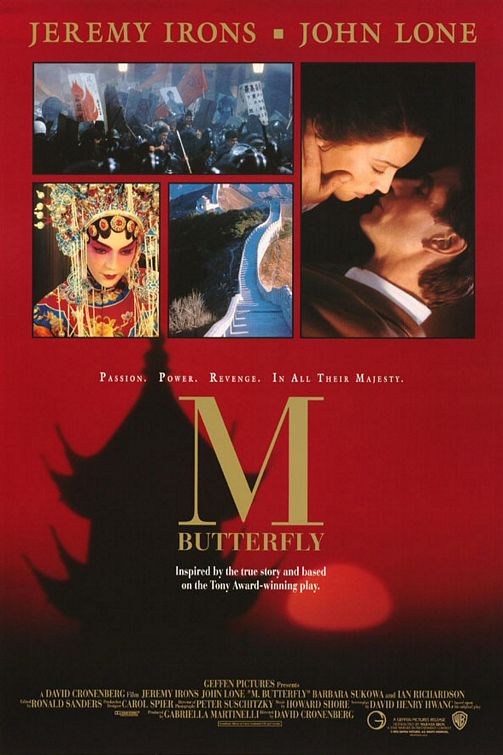
M Butterfly (David Henry Hwang)

Inspired by exaggerated true events and the opera Madame Butterfly by Puccini, David Henry Hwang’s play, M Butterfly, describes the story of a French diplomat who falls in love with the seemingly perfect Oriental woman. His fatal obsession of having his Butterfly in his hands essentially clouded his logical judgements of reality and fantasy that in fact, his Butterfly is actually a disguised communist male spy. The play has been applauded for its postmodern text that actively deconstructs preconceptions of gender and race, and sexuality in a post colonial world.


According to the medical school of Monash University, sex refers to the inherent biological differences between men and women, specifically the “chromosomes, hormonal profiles, internal and external sex organs” while gender describes the “characteristics that a society or culture delineates as masculine or feminine”. In other words, a person’s sex does not parallel his gender role in society. For Song, appearing as subservient, modest and vulnerable gave a boost to his femininity which fuelled Gallimard’s willingness to accept him as a woman, as he/she embodies the natural extensions of Gallimard’s perceptions of the Oriental woman. After gulling Gallimard into thinking that he has snared a Chinese Chio Chio San, Song first convinces Gallimard, before crushing his fantasies by destabilizing any gender and racial expectations that Gallimard holds of him. Song’s successful presentation of the Oriental cannot be singularly attributed to his understanding of Western man, but also Gallimard’s naivety and constant seeking of reassurance for his male pride. With his confidence and his career depending critically on Song’s continual submissive act, Gallimard lives in self-denial and refuses to confront the real world effects of his geisha reverie.

The adoption of the name Rene is one of great significance as Rene is a unisex name that does not echo manliness. Portrayed to be an incapable, impotent beta male in his own White culture, Gallimard’s masculinity is repeatedly contested in the play through the depiction of Helga and Renee, the bold White women that he has relationships with. In Song he finds solace as his masculinity is reassured and reinforced as he finally feels “the absolute power of a man”. The seeming psychological abuse that he imposes on Song, by leaving him/her wanting, appears to be a self-serving mentality boosting his ego and pride, thus creating the illusion that he is finally a whip in the East, when he is nothing but a wimp in his own culture. We see a foreshadowing of the complete role reversal between masculinity and femininity through the action of Gallimard pouring tea for Song. This traditional subservient feminine act is pursued out of relief at the arrival of Song, thus assuring the continuation of his fantasy. It is ironic that he achieves consolation of his manhood through these feminine acts just so the object of his fantasy will stay by him. Gallimard is flawed as he is weak mentally and delusional, traits that are traditionally associated with the idea of femininity. The fluidity of gender identities parallels that biological make-up is not a limiting factor, as shown by Song’s female persona and Gallimard’s feminine tendencies.


Despite Song’s extraordinary masquerade as a woman, his act is regularly penetrated by his masculine traits in the way he dictates the thoughts and actions of Gallimard through manipulation for what he cannot achieve explicitly. His vocal intrusion throughout the play amplifies his presence on stage, implying that he is unable to totally fulfil Gallimard’s expectations. Even when he tries hard to fit the image of the perfect Oriental woman, he cannot disregard his inherent nature of want of control. This dispels the belief that Asian men are subpar and more effeminate in comparison to the dominant White male.

The play also presupposes Orientalism as an existing and present concept. The temporal fulfilment of Gallimard’s Orientalist fantasy upheld the relationship between the two characters. Through stereotypes shaped by his own illusions about the Orient, Gallimard succumbs to the notion of the mysterious and erotically exotic as they act like a shortcut to his understanding and interpretation of the Asian culture. By dissolving the barriers to the diversity of cultural boundaries, Gallimard limits his knowledge about the operatic tradition of actors assuming the role of actresses in opera houses due to it being an artistic matter, thus allowing for the careless mistake of misjudgement of identity. Song’s overt portrayal of the Orient character then acted in his favour by skewing Gallimard’s opinions towards him. Gallimard’s obsession and total absorption with the imagined realm of his Butterfly, and his fictitious perception of reality consumes him, perpetrating his self destruction and eventual downfall.


The self proclamation by Song that he is “an Oriental” and thus can “never completely be a man” is also out of character. Orientalism is seen as a derogatory and dehumanising term used by the West in their misconceptions of the East. It reflects a whole spectrum of Western attitudes and prejudices against the Asian race and its culture. It is also atypical that a man questions his male authority and manhood with the conclusion that he does not make the cut and therefore does not encompass the quality of the male race. As such, a lack of self-respect and the act of self-degrading is reflected and the audience is left to wonder about the mental stability of a person who is willing to hide his manhood for twenty years when even his colleague is unable to identify with him, calling him belittling and offensive terms like “homos” and “pervert”. Song’s hollow victory at the end did little to lift him out of the reductive category of Orientalism. It seemed that even though in the play Hwang constantly criticises Western ideals of Asians and tries to dispel the images of the Asian race being mere play things for the West, portraying Song to be a cunning, manipulative man that will stop at nothing, even by putting himself down to the lowest just to achieve his warped means may not be the best way to do so. It acted to reinforce the stereotype of the Orient race and merely offers a repositioning of the marginalised at best.


In M Butterfly, it is clear that perceived notions of sex and gender fail to address the issue that biological make-up is not a good reflection of gender identities as one can always counter stipulated roles and expectations through the avenue of drag and deception. The ideals of Orientalism give Western men the hope that there is a Chio Chio San reincarnated out there for his taking. In this case, it acts to butter up Gallimard’s ego and pride so that he thought more highly of himself than what society deems of him, thus luring him into a false sense of security. When forced to confront the disturbing truth of his transvestite act, Gallimard chooses to commit suicide to keep his heterosexual union and fantasies of the Orient intact.

Monday, 12 November 2012

Book Review: A Heart So White

A Heart So White is a novel by Javier Marías. It was first published in 1992 and received the International IMPAC Dublin Literary Award in 1997. 

The following is a summary of the book by Samantha Schnee:


Juan is a newlywed translator who shuttles between the UN in New York and the Hague for six to eight weeks at a time, while his young bride Luisa, also a translator, remains behind in Madrid to establish their home together. In Juan's absence she develops a close relationship with her enigmatic father-in-law, a charismatic art dealer named Ranz who, though in his seventies, has not lost the charm that enabled him to marry three times despite the fact that his first wife died mysteriously and the second committed suicide upon returning from their honeymoon. 
Juan has never enjoyed a particularly close relationship with his father, and though he cannot put his finger on exactly why, he has great misgivings about the friendship developing between his father and his spouse. Juan's feelings of unease and his difficulty accustoming himself to the conventions of conjugal life are refracted through many lenses: a conversation between a Spaniard and his Cuban lover that Juan and Luisa overhear while they are on their honeymoon in Havana; a one-night-stand that Juan facilitates for his friend and former lover, Berta, while he is staying in her apartment on one of his stints at the UN in New York; and descriptions of Juan's own family history, specifically his father's marriages. Juan is dogged by feelings of dread which seem to become more acute rather than abate the longer he is married.
Read more: http://wordswithoutborders.org/book-review/a-heart-so-white-by-javier-maras#ixzz2C0XCLX1t


While the words are beautiful, A Heart So White is written in extremely long sentences, and readers may lose their concentration half way or feel the need to read every sentence two or three times before they can properly grasp the meaning behind it. Personally, I feel that the first chapter was excellent, the dramatic tenseness in the air, the engaging words made me have very high hopes for the book. But it was all lost once I reach the second chapter. There were a lot of unnecessary events happening through out the book, which made me restless. But it was redeeming towards the end when the pace picked up.

Here are some of my thoughts on it:

Heart, much like Great Expectations, takes on a reflective tone and is structured such that past events parallel the present. Through this form of narrative, the protagonist, Juan, appears as a wiser person who is more knowing. However, throughout the narration, the protagonist showed a strong sense of discomfort at the slow unfolding and revelation of events, he is encasing himself in a safe haven and his father’s confessions robs him of his illusions and taints his impression of his father.

Although Juan claims that he “obliged” Luisa to love him, it seems that he himself was “obliged” into the contractual marriage, epitomizing that marriage is the tombstone of love. Although he does show some degree of affection towards her, he is constantly filled with dread and apprehension for their future. Through repetitively questioning “what now” and demonstrating dismay at the lack of an abstract future, he shows conflicting behaviour of that of newlyweds. Juan is also revealed to be an effeminate character. He thinks highly of himself and his morals, and employs mannerisms of self-justification whenever he catches himself falling short. He justifies his early return from Geneva as a “surprise” for Luisa, trying to pass it off as something nonchalant and fun, covering his real motives in spying on her and trying to catch her off guard, displaying a deep distrust in his wife.

Juan’s dissatisfaction with Luisa also shows through in his subtle hints at her manipulative nature, with words like she “orchestrate[d] the conversation” and “didn’t overplay her persuasiveness” , even though she felt that her actions were for his benefit. Moreover, Juan gives the impression that he is subconsciously jealous of the close bond Luisa has with Ranz and finds it distasteful. His bitterness is apparent when he asked her “You mean you haven’t asked him already? You see enough of each other”. It hints at Juan’s deeper desires to be closer to his father emotionally, but his intimidation by his father falters him, and he is scornful when Luisa gets there before him. However, Juan’s relationship with Ranz drastically improves after his confessions to the murder. His wrongdoing and weakness made the once-perfect father seem now almost human. Where he was once youthful, charismatic and charming, he now suddenly ages speedily in Juan’s opinion, becoming “old” and “weary” as a result of his flaws.

We don’t see as much development in Juan’s marriage though. Where love is supposed to overcome secrecy, Juan does the contrary by keeping secrets from Luisa, attributing them to facts not amounting to the importance of sharing. He also told Luisa “barely credible stories”, one may argue that he is trying to keep Luisa “entertained”, but lies do not build the foundation of marriages. Unlike the speculation he often does with Luisa, we see Juan being more direct and forthcoming with Bertha. He frequently expresses a desire to share his feelings and experiences with this old friend, lamenting that he is unable to see her as often as he likes and that he now has to “store up for much longer all the events and anecdotes…which I habitually keep for her”, exposing his anticipation in seeing and hearing from her, and revealing a desire to be close to her on a psychological level, which is lacking in his relationship with Luisa. References to Bertha and their shared experiences, and Miriam, also interjects the last two chapters. His imagining of Bertha, as opposed to the need to consciously find an abstract future with Luisa, drives home the point.

Love should bring about a desire for intimacy, but we see that lacking in Juan’s marriage. Although they are newlyweds, the touching of bodies does not seem to bring about a provocation of desire. Juan regards physical proximity with Luisa as an invasion of his space and privacy, even though he did not express his discontent explicitly but through the recurring reference to them having to share pillows. Even when their bodies were touching on numerous occasions, it fails to stir Juan’s fantasies. In one instance, Juan’s mind is absentmindedly preoccupied with memories of Miriam even when Luisa’s breasts are “brushing against [his] back in bed”. This lack of lustful arousal lies in stark contrast to his state of mind in just seeing Bertha naked. We see a very different Juan when he throws caution out of the window and engages words like “cunt”, suggesting a heightened state of arousal. It appears that he longs for, and has a deeper and more personalized relationship with Bertha, divulging much more passion and emotions that he ever did with Luisa, where their love is portrayed to be very bland and dull. This leads readers to question his motives in going through with the marriage and if he did it out of a sense of duty, and not love.

Ranz’s self-confidence may be a point of insecurity for Juan, because he constantly compares himself to his father and sees his inferiority embedded in Ranz’s seeming perfection. Hence, the strained and awkward relationship may be a self-protection mechanism on Juan’s part. But he is now able to seek closure and effects emotional bonding because the burden is lifted with the truth coming to light. On the other hand, Juan’s relationship with Luisa seems stagnant, or at a point of stasis. Although he does not deny the attractiveness of Luisa and his affection towards her, he is never enthusiastic about their encounters. She fails to arouse emotions and passion in him, even less so for sexual desires. His reluctance or subtle regret in the entering of the contractual marriage reveals his non-commitment and lack of sense of fidelity, even though he claims that he is slowly getting used to it. In contrast, we see a building up of Juan’s preference for interactions with Bertha, with her interjecting the last two chapters at various points of his narration. Bertha and Miriam may then be a mirroring of his welcoming of future affairs, either for himself, or Luisa.

Wednesday, 10 October 2012

The Casual Vacancy

I couldn't wait to get my hands on The Casual Vacancy the moment it released, but being a poor student, I didn't want to spend a week's allowance to buy the book either. So after a week or two of waiting (I reserved it with the library), I finally got my hands on it.


In case you didn't know, I have loved J.K Rowling from the first time I read her book (Harry Potter and the Goblet of Fire) in primary 4. She has this amazing way with words that just absorbs you completely into the world she has created and you have no way of putting the book down until you've poured over every single page, every single sentence. And then afterwards, you spend your time relishing the memories of the book. She is just that good.

But honestly, when I first read the preview for The Casual Vacancy, I just felt, mehhh, the plot didn't sound too interesting. And in my mind I was like, oh no shit, I really want something that lives up to her name. Please, please please let it be good. But the cover design didn't give me much faith either. It's so...plain. Not even in a nice way. It feels as if the publisher can't be bothered, and he's just thinking like, no matter how shitty it looks, people will still buy it just because. Which...is true. But still, you know, even a photo of Rowling instead would have been much better I feel.

So either way, I picked up the book having a teeny weeny bit of high expectations, but consciously telling myself not to. But seriously, I was bored.


Because the centrality of The Casual Vacancy was kind of political, with people vying for the position and lots of other things, and politics is just not. my. thing. I wasn't very patient with it. Moreover, the pace of the story was so slow, and there were so many characters and I had such a hard time making them out, because you know, I just didn't feel that connection that I had with the Harry Potter characters. With Harry Potter, it was like I knew every single one of them, I knew how their characters are like, I know their flaws but I still loved them. I went through their ups and downs with them.

But in this book, it was so dark and crude and cynical most of the time. I couldn't empathize with the characters as much as I want to, maybe because I couldn't understand the situation that they are in no matter how hard I tried. And it feels like the story was just really slow, I mean, her words are still beautiful, but it just felt like nothing much was happening. And at the start, I had to stop every time she went between characters to recall who they were and what their background was supposed to be.

And then, you get all this scenes of rape, of constant vulgarities being hurled around between friends, between husband and wife, between children and parents, and there's drug abuse, child neglect, sex and erections, self mutilation, class issues, race issues, and on and on. And it just feel so wrong coming from Rowling. I mean, I kind of expected this already from the many reviews out there, but it just felt so wrong when I was doing the reading. I felt like I was intruding into something I didn't mean to.


And the whole tone of The Casual Vacancy is just so...bleak and dark, and hopeless. Everybody was harbouring secrets, everybody was unhappy in one way or another, everybody was being cynical and hypocritical and thinking really mean thoughts in their heads. I just...I just wanted something more magical you know. So there were many times I had to put down the book, or just make myself continue reading even though I wasn't very keen on it.


But things started really perking up towards the last 70 pages or so. That was when the story became really tight, and then you start to finally see some action, and everything just went quickly and developed from there. It started getting really intriguing and that was when you really start to feel for the characters.

But it should have been that way from the start. I saw a glimpse of the excitement I felt towards Harry Potter, towards the end of the book, but it was so short-lived it felt unreal.

I'm just saying, if it had not been written by Rowling, I would have given it a 4 out of 5. But coming from Rowling, I guess it's a mere 3 at most.

I'm just hoping her next book would be a more exciting one. Mystery maybe?